
Spiral Wound Gasket
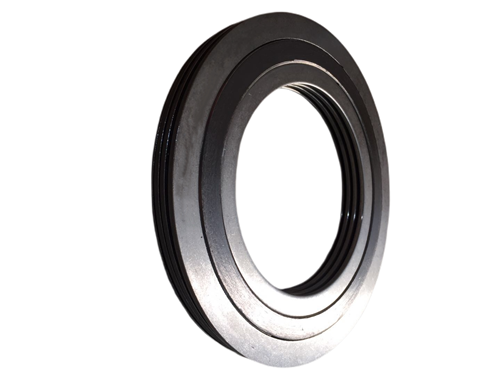
A spiral wound gasket is a semi-metallic gasket that combines the strength of metal with the resilience of a soft filler material. It is constructed by winding alternating layers of a thin metal strip (like stainless steel) and a non-metallic filler material (such as graphite or PTFE) into a continuous spiral. This design makes them ideal for sealing in high-pressure, high-temperature, and corrosive environments in industrial applications like flanged connections.
Construction and components
-
Inner and outer rings:
Some designs include solid inner and outer rings. The outer ring acts as a centering and compression-restricting device. The inner ring prevents the filler material from extruding into the pipeline.
-
Winding:
The alternating layers are wound in a continuous spiral to form the gasket.
-
Metal strip:
A thin, V-shaped metal strip, often made of stainless steel, provides strength and recovery.
-
Filler material:
A soft, non-metallic material, such as graphite or PTFE, provides the sealing properties.
Key features and applications
-
Resilience:
The spiral design allows the gasket to dynamically recover under varying loads, making it suitable for systems with temperature fluctuations, pressure surges, and vibration.
-
Sealing efficiency:
The combination of metal and filler provides a high-performance, reliable seal in demanding conditions.
-
Wide temperature and pressure range:
They can be used from cryogenic temperatures up to very high temperatures and in pressure services ranging from vacuum to high-pressure flange ratings.
-
Corrosion resistance:
Because they can be made from various metals, they can be used with almost any corrosive medium.
-
Common uses:
They are widely used in industries such as oil and gas, chemical, and power generation for sealing pipelines, valves, and heat exchangers.
Installation considerations
-
Centering:
The outer ring helps to center the gasket within the flange, ensuring even compression.
-
One-time use:
Spiral wound gaskets are designed for one-time use; after compression, they deform and should not be reused.
-
Testing:
It is often recommended to use a separate gasket for initial pressure testing before the final installation.